Welcome to the Integrative Pain Laboratory!
We are aiming to gain a deeper understanding of chronic pain conditions to develop
new ways of measuring, preventing, and treating chronic pain. 

We are supporting chronic pain patients and medical specialists in learning and integrating the new knowledge about chronic pain, boosting the healing process.

PDSR – Personalized Danger Signal Reprocessing  

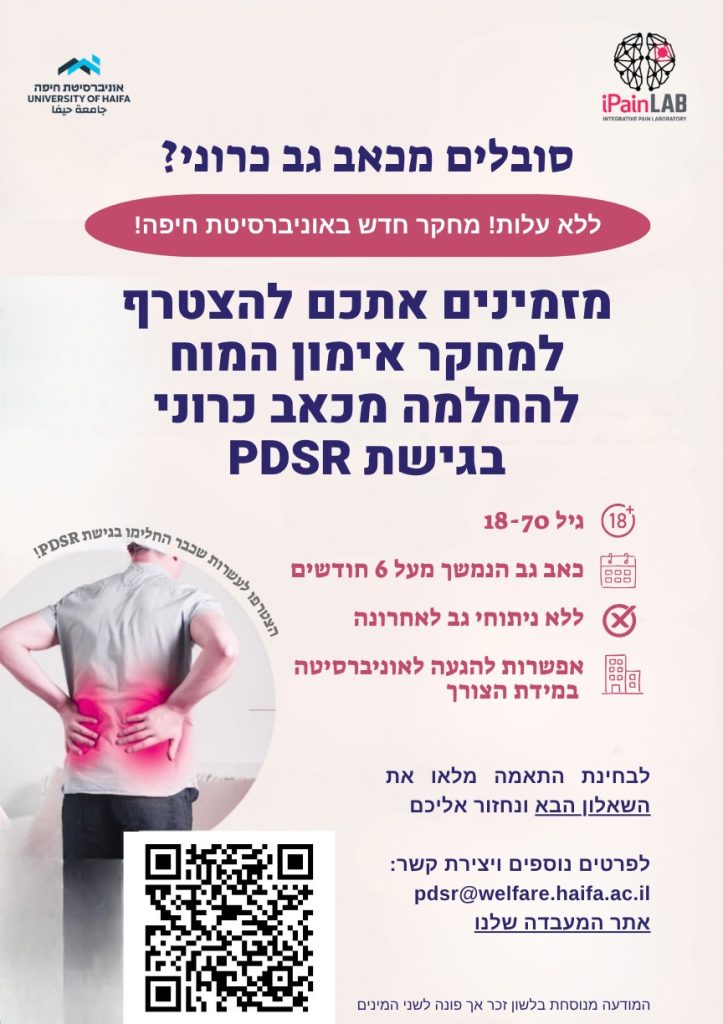
Suffering from chronic back pain?

Join our research study on the PDSR approach for pain recovery

PERSONALIZED DANGER SIGNAL REPROCESSING (PDSR) – A method focusing on how the brain processes pain signals.

WHO CAN PARTICIPATE?

  • Age: 18–70

  • Back pain lasting more than 6 months

  • No recent back surgeries

  • Ability to arrive at the University of Haifa if needed

WHAT DOES THE STUDY INCLUDE?

  • A diagnostic session with a physician

  • A learning and treatment process with the research team

  • Guided practice sessions

  • Completing questionnaires before, during, and after the intervention

  • Total duration: Approximately 2 months
 

לבחינת התאמה, אנא מלאו את השאלון הבא ונחזור אליכם
https://haifauniversity.qualtrics.com/jfe/form/SV_8BpHdkP86z4ze4e

לפרטים נוספים ויצירת קשר
pdsr@welfare.haifa.ac.il

המודעה מנוסחת בלשון זכר אך פונה לשני המינים כאחד
PDA – Pain, Depression, Anxiety

What if we could LISTEN to pain – instead of just asking about it? 

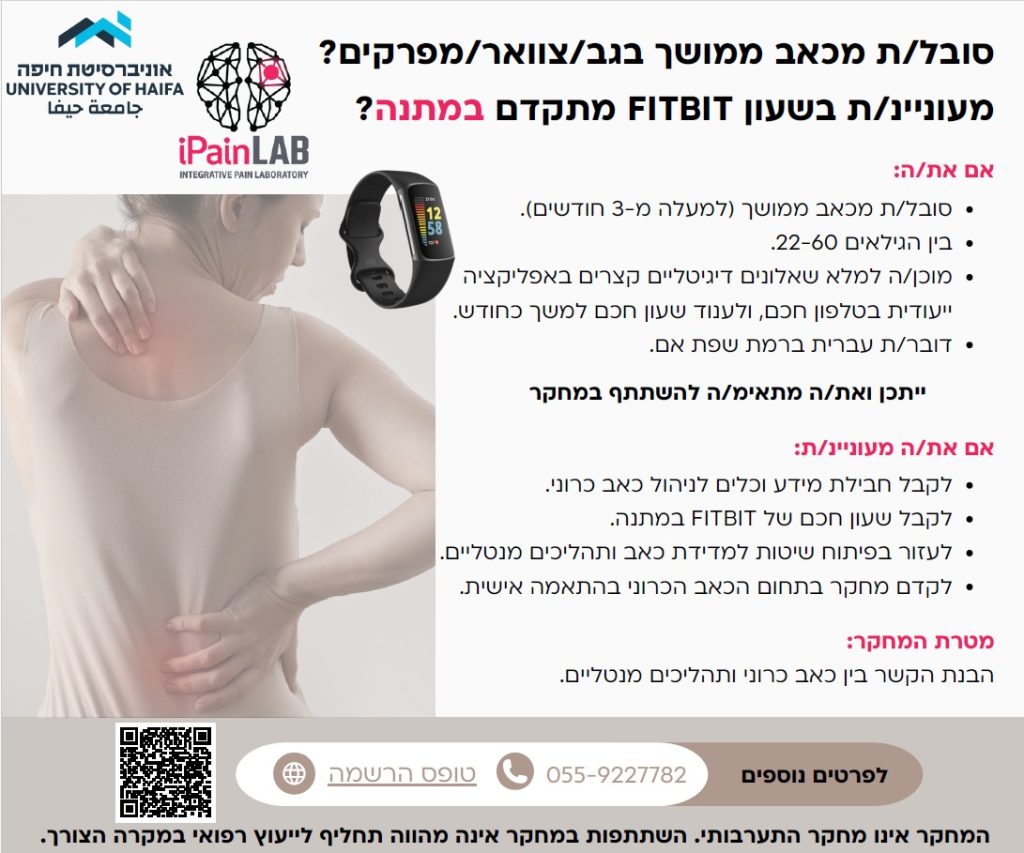
At the Integrative Pain Laboratory (iPain Lab) at the University of Haifa, we are launching a cutting-edge study to decode the complex relationship between chronic pain and daily life.

We believe pain isn’t just a signal; it’s a story. 📖

By using wearable technology and a dedicated app, we can finally track that story as it unfolds in real-time—monitoring sleep, emotions, stress, and movement.

📍 WHAT MAKES THIS STUDY UNIQUE?

GET A FREE SMARTWATCH: Participants receive a Fitbit as a gift.

PERSONALIZED INSIGHTS: Receive a toolkit to understand your unique pain patterns.

FUTURE CARE: Opening doors to potential therapeutic options within our lab.

📍 WHO CAN PARTICIPATE?

👥 Men and women aged 22–60. 🕒 Experiencing chronic pain (3+ months) in the back, neck, knees, or joints. 🇮🇱 Native Hebrew speakers. 🚫 No prior diagnosis of Fibromyalgia.

📍 WHAT’S INVOLVED?

It’s simple: Wear a smartwatch for one month and complete short daily surveys via our app. 📱⌚️


✉️ לפרטים ולהרשמה:
haifauniversity.qualtrics.com/jfe/form/SV_4GXNQDf1e8P45Fk

לפרטים נוספים ושאלות מוזמנים לפנות
shaked2746@gmail.com


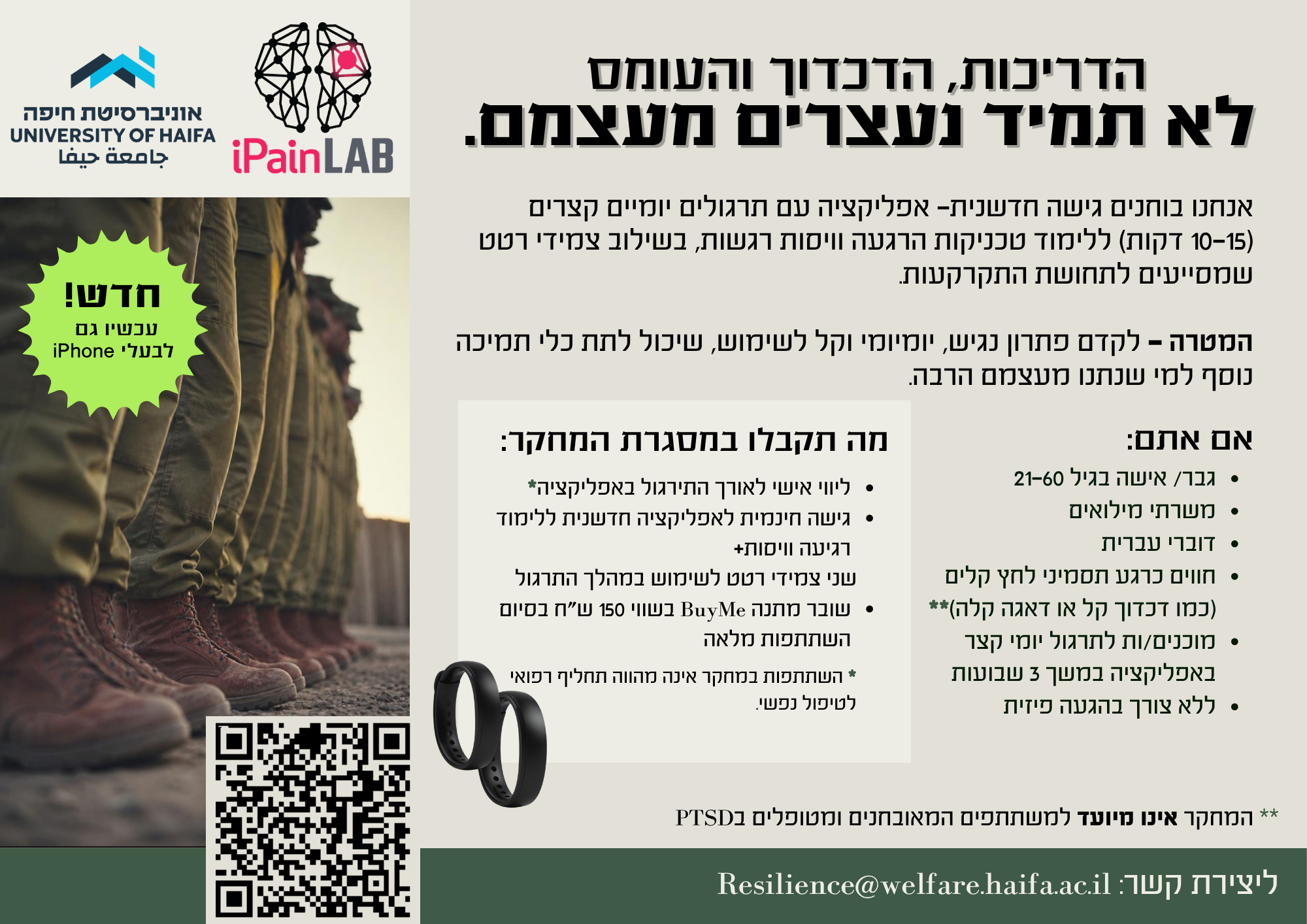
הדריכות, הדכדוך והעומס לא תמיד נעצרים עם סוף המילואים

כשאתם חוזרים מהמילואים- מגיע לכם להרגיש תחושת חוסן ואיזון, ואנחנו פה בשבילכם.

מוזמנים להשתתף במחקר הבוחן יעילות בשימוש באפליקציה המשלבת גישה טיפולית של תנועות עיניים ורטט עדין בעזרת צמידים ללימוד טכניקות הרגעה וויסות

המחקר נפרש לאורך 3 שבועות, בו לומדים כל יום שיעור קצר על שיטות הרגעה, ויסות והתקרקעות באפליקציה שנמשך בין 10-15 דקות.

האפליקציה מיועדת לתמיכה במשרתי מילואים שחווים עומס, דריכות, דכדוך או דאגה קלה בעקבות השירות – אבל ללא אבחנה פעילה של PTSD. אלו שמרגישים שהחזרה לשגרה לא פשוטה עבורם ופתוחים לנסות כלי חדשני ונגיש

פותח ע”י צוות מקצועי, חלקם מילואימניקים- עבור מילואימניקים💪🏼

למילוי שאלון התאמה https://haifauniversity.qualtrics.com/jfe/form/SV_83bPb2dkhcL9Quq

PAIN Journal – New Publication 

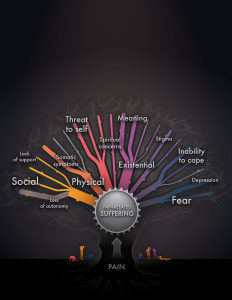
One of the pleasant surprises at IASP 2024 was seeing the latest issue of PAIN Journal with our research featured on the cover. Our paper, “Defining Suffering in Pain: A Systematic Review Using Natural Language Processing,” focuses on the complexity of pain-related suffering.
In this study, we identified eight key dimensions and developed a new conceptual framework, combining a systematic review with advanced machine learning techniques. We hope this contribution will enhance the understanding of pain and suffering in both clinical and research settings. Read full article>>

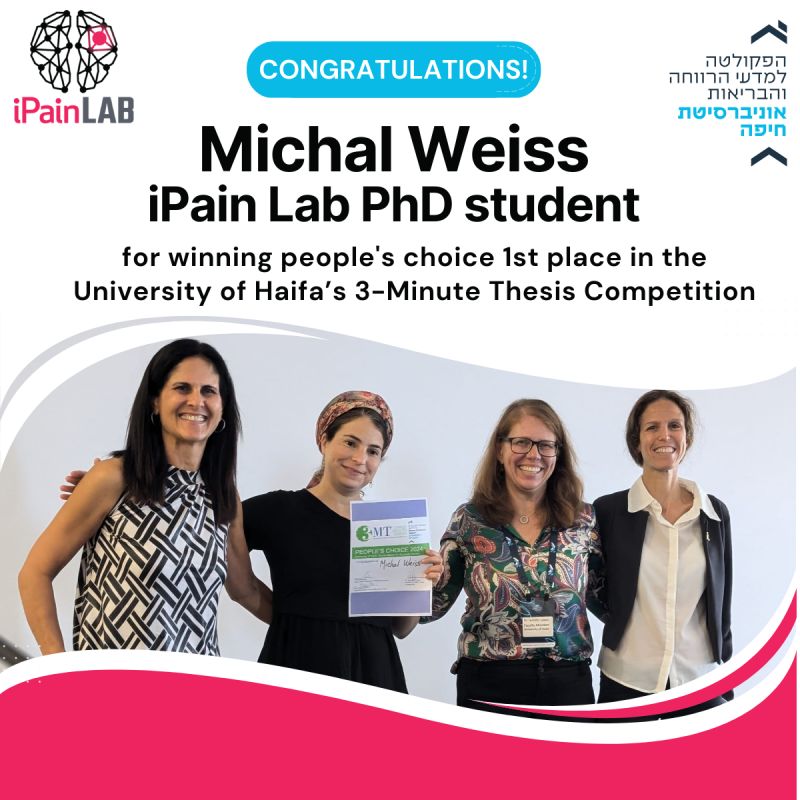
People’s choice 1st place in the 3-minute thesis competition

🎉 Congratulations to our lab member Michal Weiss for winning the People’s Choice 1st Place at the University of Haifa’s 3-Minute Thesis Competition! 🎉

Michal presented a fascinating segment of her PhD research, focusing on the development of a diagnostic tool for Fibromyalgia. Her presentation, titled “Can we smell pain?” is based on the current goal to non-invasively detect pain-related chemicals in sweat, enabling more effective diagnosis and monitoring of chronic pain conditions. Her work not only sheds light on the intriguing connection between pain and biochemical compounds, but also offers hope for faster and more accurate diagnosis of Fibromyalgia.

Well done, Michal, for your outstanding achievement and contribution to pain research!

Publications

Understanding and dealing with pain-related suffering is a big challenge in healthcare and research. But there’s no agreement on exactly what it means, and it’s often not clearly defined in studies. Here, we did three things: (1) looked at how pain-related suffering is understood in existing research, (2) made our own definition and framework, and (3) checked our results using machine learning. We found 111 articles in our search and used a new method to analyze them. From this, we defined pain-related suffering as a very negative, complex experience when someone feels their well-being is threatened. We also created a framework with 8 dimensions to understand it better: social, physical, personal, spiritual, existential, cultural, cognitive, and affective. Our findings show that pain-related suffering is different from but closely connected to pain itself. This analysis gives direction for more research in this area. Read full artice>>

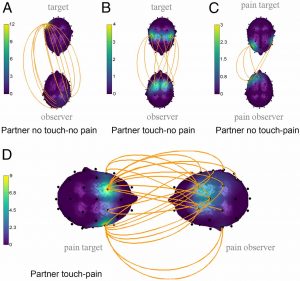
The mechanisms that underlie social touch analgesia are largely unknown. Here, we apply a hyperscanning approach with real-life interaction of dyads to examine the association between brain-to-brain coupling and pain relief. Our findings indicate that hand-holding during pain increases the brain-to-brain coupling network that correlates with the magnitude of the analgesia and the observer’s empathic accuracy. These findings make a unique contribution to our understanding of the physiological mechanisms of touch-related analgesia. Read full artice>> 

We developed a mobile platform for measuring pain, emotions, and associated bodily feelings in chronic pain patients in their daily life conditions. We developed predictive models of future pain based on the interactive effects of (a) body maps of fatigue with negative affect and (b) positive affect with past pain. Read full article>>

In the media:

Mako (10.02.2021): רוצים לסבול פחות מכאבים כרוניים? תנוחו יותר ותשליכו רגשות שליליים